



Review finds that significant progress has been made but more work to do, with more than half the targets ‘at risk’. This is mainly due to resource issues, training needs and delays in required legislation.
An assessment of An Garda Síochána’s policing performance throughout the first half of 2025 has found that 7 of 18 targets are reported as ‘on target’ with the remaining 11 ‘at risk’.
The Policing and Community Safety Authority recognises progress in several areas.
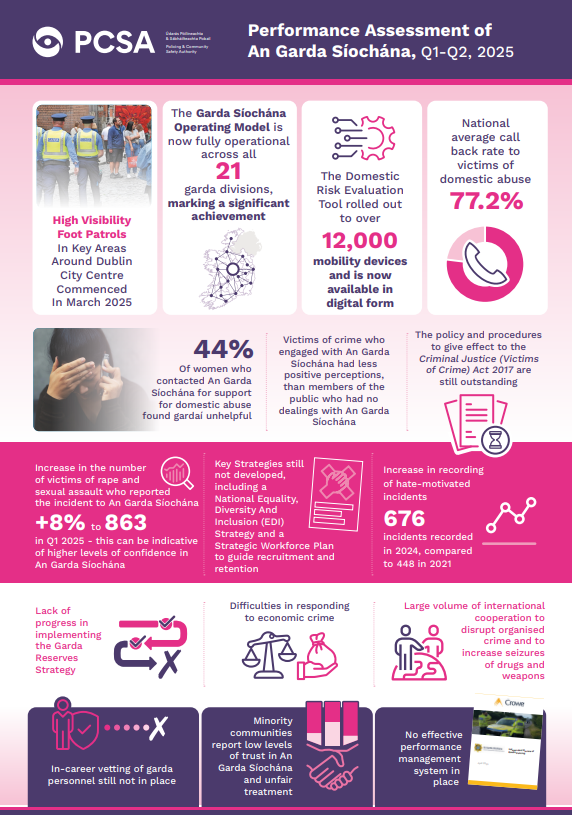
The Garda Síochána Operating Model became fully operational across all 21 garda divisions in the first half of 2025.
The commencement of high visibility foot patrols in key areas around Dublin city centre is positively acknowledged and the large volume of international cooperation to disrupt organised crime and to increase seizures of drugs and weapons has been a significant policing success.
Click here to read the full report.
However, there are areas where further development is needed to fully deliver on the Policing Priorities and commitments made within the 2025 Annual Policing Plan.
This assessment highlights significant concerns about recruitment and retention of gardaí and garda staff, management of garda resources, delays in the introduction of key policies and strategies, and performance management issues.
The assessment is based on a wide range of engagement with garda members and staff at various ranks, as well as key stakeholders. It is also based on reviews and analysis of performance reports and data received from An Garda Síochána, offering an evidence-based reflection of policing activities and outcomes.
Key Findings:
- The Garda Síochána Operating Model is now fully operational across all 21 divisions. This represents a significant milestone for An Garda Síochána.
- Recruitment and retention of personnel remain a significant challenge, with key strategies and plans to address this challenge (Recruitment and Retention Strategy; Strategic Workforce Plan; Training Strategy) not been produced.
- A Human Resource Information System (HRIS) to allow a detailed financial and human resources management capacity is still not in place.
- There was some good progress to enhance and speed up the recruitment process, as well as to increase the diversity within the organisation.
- The mandatory call-back rate to people who have reported domestic abuse stands at 77.2%. Positively this overall rate is above the 60% target, but concerns arise due to inconsistencies across divisions, with some demonstrating rates below the target.
- The recorded crime rates of rape and sexual assault (+8% cent to 863 in Q1 2025), and other sexual offences (+16% to 111 in Q1 2025), have both increased, relative to the same period of 2024. This can be indicative of increased awareness, greater confidence to report, as well as an enhanced appreciation of the efforts An Garda Síochána is investing in this area.
- There is continued success in identifying, targeting and disrupting organised crime, with large amounts of drugs, cash and weapons being seized.
- While An Garda Síochána has enhanced its cybercrime capacity and capability, it is still challenged in its efforts to keep pace with the consistent growth in this type of crime.
- An Garda Síochána still does not have an effective performance management system in place for any of their personnel, either garda members or garda staff.
- There has been no significant progress made in the introduction of in-career vetting and randomised drug testing.
Commenting on the report, PCSA Chief Executive Helen Hall said:
“This assessment of policing performance is one way in which we let the public know how gardaí are doing against the Garda Commissioner’s commitments in his annual Policing Plan.
“As the report shows, there were significant achievements in the first half of 2025, such as the rollout of the garda operating model across all garda divisions but also, and probably more obvious to the public in Dublin, the rollout of high visibility patrols.
“However, we remain concerned about the lack of an effective performance management system for gardaí and garda staff and the lack of progress in the introduction of in-career vetting and drug-testing. We are also concerned about the organisation’s capacity to address cybercrime cases, which are rising constantly. We are particularly concerned by the statements of many gardaí, who feel they do not have the relevant training to properly handle such cases.
“While we acknowledge the efforts An Garda Síochána is making to contact people who have reported domestic abuse within the required seven days, we are concerned about the inconsistencies across divisions and we reiterate the need to review the quality of these call backs.”
The evaluation is based on the PCSA’s statutory oversight framework, which consists of the Policing Priorities, An Garda Síochána’s Statement of Strategy, and the annual Policing Plan.
Looking ahead, the PCSA will be discussing conduct and discipline in the service, as well as the rollout of tasers to frontline gardaí, at its upcoming monthly meeting with the Garda Commissioner and senior colleagues on Thursday 18 December.