



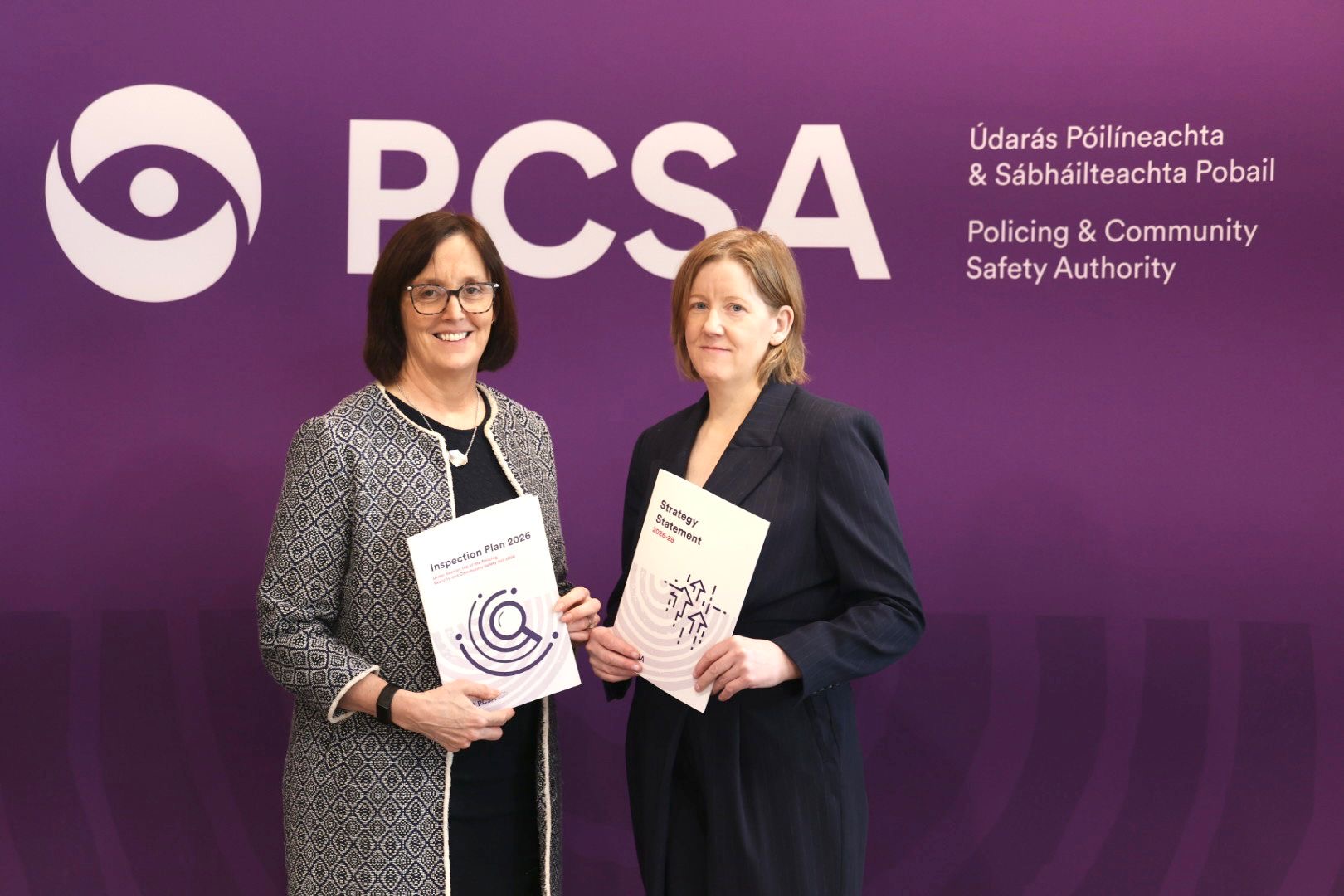
 The Policing and Community Safety Authority (PCSA) today publishes its first Strategy Statement (the Strategy) along with two underpinning documents, the PCSA Inspection Plan 2026 and an overview of the PCSA Business Plan for 2026.
The Strategy sets out our overall objective to independently oversee and assess An Garda Síochána to ensure the policing services provided to all communities are effective, consistent, and fair.
PCSA Strategy Statement 2026-2028_English
To achieve this, the strategy sets out four strategic objectives for the 2026-2028 period:
Provide Consistent Oversight and Independent Assessment;
Support and Promote Community Safety;
Be a Credible, Trusted, and Expert Voice on Policing; and
Be a Well-Run and Effective Organisation.
The key actions we will take to realise these objectives are provided in the Strategy, along with actions we will undertake to deliver against our public sector duties on human rights and community safety.
The Strategy is underpinned by a detailed business plan, an overview of which has also been published. This sets out the actions we have planned for 2026, including to:
Conduct in-depth oversight on homicide investigations, policing of children and young people, roads policing, and responses to domestic, sexual and gender-based violence;
Meet extensively with community groups and stakeholders to understand their experiences of policing and community safety;
Build our research and data capacity; and
Develop our human rights capacity.
Inspection Plan 2026
The inspection work of the PCSA is a key element of our oversight of An Garda Síochána and we commit to undertake four inspections in 2026.
These are detailed in our statutory Inspection Plan 2026, also published today.
In summary, this year we will inspect:
Call Handling and Incident Response Procedures – the use of ‘Resolution without Deployment’;
Risk management in garda custody;
The policing of bail conditions by An Garda Síochána; and,
The management and storage of biological samples by An Garda Síochána.
Commenting on the launch of these three documents, PCSA Chairperson Elaine Byrne said:
“The launch of our first Strategy, statutory Inspection Plan, and overview of our Business Plan for 2026 is an important moment for the PCSA. These documents detail how we will go about our work and ensure that we are transparent, open, and accountable in the way we go about that work.
“We engaged with a number of stakeholders in the design of these documents, including through the public consultation on the Strategy. We would like to again express our thanks to those who engaged with us throughout this process.”
The PCSA has a statutory function (under section 137 of the PSCS Act 2024) to set a three-year strategy statement setting out its key objectives for that period. As per the Act, PCSA published a draft of its strategy on our website in October 2025 for the purposes of public consultation and feedback. Thereafter, the Authority approved the PCSA Strategy and submitted it to the Minister for Justice, Home Affairs and Migration in December 2025.
The Business Plan for 2026 underpins this Strategy, setting out how we will work to progress the strategic objectives this year.
Overview of PCSA Business Plan 2026
There is a similar statutory requirement (under section 146 of the PSCS Act 2024) for the PCSA to prepare and publish an Inspection Plan, setting out the priorities for inspection. The plan sets out the areas of policing that we will inspect during 2026 and describes how we will carry out and report on our inspections.
The four areas that have been selected for inspection in 2026 are as follows:
Garda Call Handling and Incident Response Procedures – the use of ‘Resolution without Deployment’
In certain circumstances, an incident reported to a garda Regional Control Centre may be resolved without deploying garda resources and it is categorised as ‘Resolution without Deployment’. If garda resources are inappropriately dispatched to incidents that could be resolved without deployment, this may result in reduced availability for higher priority calls or other policing tasks.
The purpose of this inspection is to examine the use of ‘Resolution without Deployment’ to ensure it is applied appropriately and consistently in accordance with garda policy.
Risk management in garda custody
The purpose of this inspection is to examine the garda approach to identifying, assessing and managing risks associated with persons in garda custody. This inspection will focus on those in custody who may be more vulnerable, including those in mental distress.
The policing of bail conditions by An Garda Síochána
The purpose of this inspection is to examine the extent to which bail conditions are proactively and effectively policed and how breaches are dealt with by An Garda Síochána.
The management and storage of biological samples by An Garda Síochána
The purpose of this inspection is to examine the arrangements for the management and storage of biological samples. It will assess whether samples are properly accounted for, appropriately stored and recorded on the Property and Exhibits Management System, and whether the processes are applied consistently.